
Nearly every battery-powered product has a management system. Far fewer have an architecture that decides, moment to moment, which energy to spend and where. That gap is where performance is being lost.
Two Systems, Often Confused
When engineers first hear about Premergy’s Battery Control System, the reasonable first reaction is: we already have a BMS. Almost everyone does.
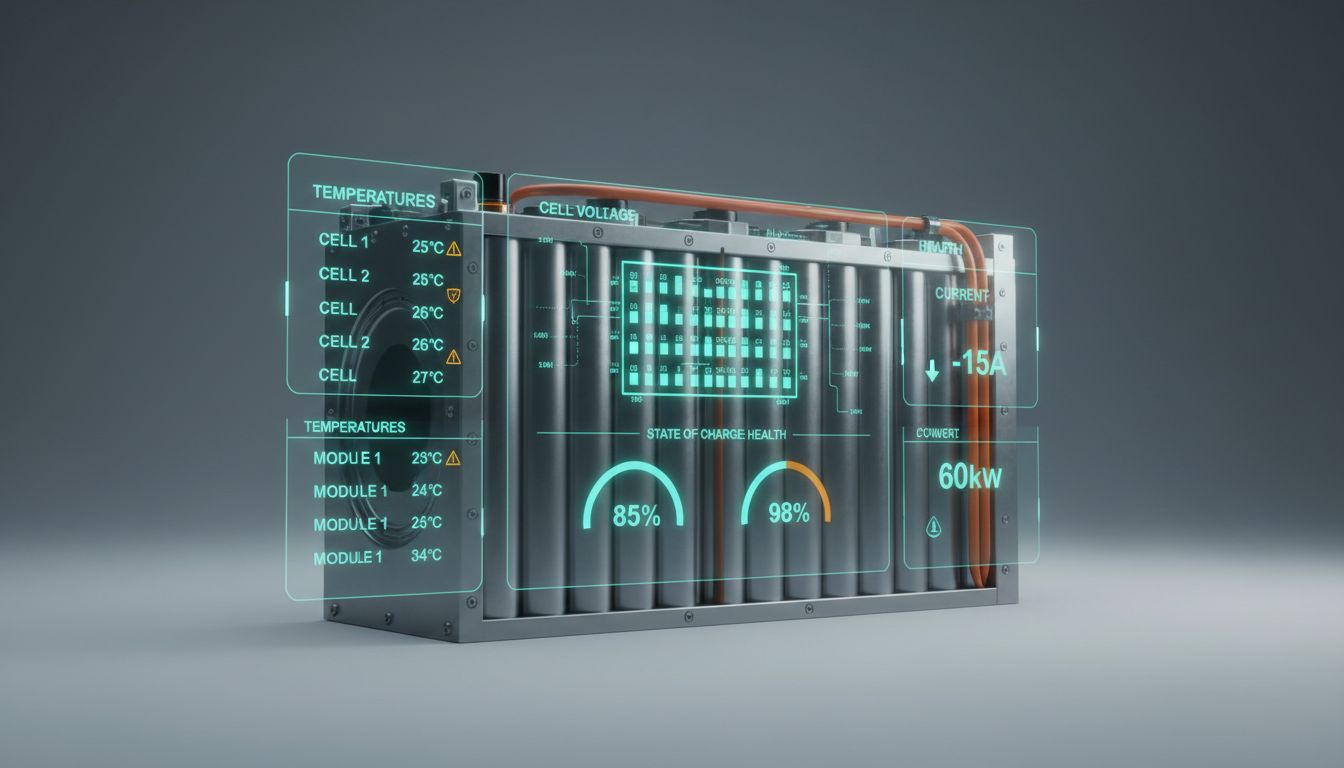
A conventional battery management system does essential work. It watches voltage, current, and temperature, estimates state of charge and state of health, balances individual cells, prevents overcharge and over-discharge, and reports data to the rest of the system. When a limit is crossed, it acts, up to and including disconnecting the pack.
That is a guardian’s job. Its purpose is to keep the battery inside a safe operating envelope, and it does that well.
What a BMS generally does not do is decide how that energy should be deployed. It accepts the load it is given. When a motor demands a surge, the pack delivers it. The BMS steps in only when that demand approaches a boundary.
So nearly every conventional architecture shares the same implicit strategy: one uniform bank of cells, asked to do everything, protected at the edges.
A Boundary Is Not a Decision
The two systems answer different questions.
Protection asks: Is this safe?
Control asks: What is the best way to meet this demand right now?
A BMS works like a circuit breaker paired with a fuel gauge. A control system works more like a dispatcher, deciding which resource should handle each request before the request strains the system. Both are necessary, and neither can substitute for the other.
Where the Losses Actually Occur
Real duty cycles are not steady. Vehicles cruise, accelerate, climb, and slow down. Aircraft take off, climb, hover, transition, and descend. A single chemistry can be tuned for one of those conditions and is compromised in the rest.
The costliest moments are the transients. High-current surges increase resistive heating, and resistive losses rise with the square of the current. That heat accelerates degradation, and the thermal management system then spends more energy removing it.
A BMS can observe all of this and cap it. It cannot avoid it, because it has nowhere else to send the demand. With one bank, every load lands on the same cells.
What a Control Layer Adds
Premergy’s three-part architecture adds the decision-making a BMS does not provide.
Multi-chemistry banks. One bank supplies steady cruise power and is chosen for longevity and thermal stability. The other supplies surge power and is chosen for high-current output, so the primary bank is not degraded by the demands that wear it fastest. The cells are ordinary. The way they are organized is not.
Adaptive regeneration. In automotive applications, the system captures energy during deceleration at speeds as low as 5 mph and sends the recovered charge to whichever bank can absorb it most efficiently at that moment.
The Battery Control System. The BCS decides in real time which bank handles each demand, using torque demand, charge state, and thermal conditions. It works in three tiers: a Supervisory Controller for system-level decisions, a Drive Mode Controller that optimizes operating profiles, and a Switching Controller that manages real-time bank transitions.
Just as important is what the BCS is not. It is not a drop-in replacement for the battery system a platform already has, and adopting it does not mean rebuilding that system. The BCS is a decision layer designed to integrate with an existing battery and power architecture with minimal software rewriting. What changes is not the protection already in place, but what that protection is asked to handle.
What the Evidence Shows
Premergy took the architecture to independent testing. At Clemson University’s International Center for Automotive Research, it demonstrated a greater than 20% efficiency improvement in an automotive application. The program ran more than 100 dynamometer hours and more than 700 miles of on-track validation at Atlanta Motorsports Park.
The most telling result was a different one: zero thermal events. The thermal management system never activated across the entire program. That follows directly from the design. When the energy-dense bank is never asked to absorb the current spikes that generate heat, there is far less heat to manage.
Those results come from an automotive platform, and we are careful to say so. Other applications need their own validation. For drones and UAVs, preliminary analysis points to 15-25% more flight time. That figure is a target rather than a measurement. It depends on the multi-chemistry configuration rather than on control logic alone, and it has to be proven on each platform, in its own application, before it means anything more than an objective worth testing.
Five Questions Worth Asking About Your Own Architecture
- When a surge demand arrives, does your system decide where it goes, or does it simply deliver it?
- Where does recovered energy go, and is that the place best able to absorb it?
- How much of your thermal budget is spent managing stress your own architecture created?
- Is your pack’s chemistry chosen for your real duty cycle, or for its most demanding moment?
- Can your energy logic improve after the product ships?
If the honest answers are that it simply delivers it, that recovered energy goes wherever it can, and that a good deal of the thermal budget goes to self-inflicted heat, then the limiting factor is probably not the cells.
Different Layers, Different Jobs
The BMS will remain essential, and Premergy is not proposing to remove it. Protection is table stakes, and every serious battery product needs it.
The competitive difference over the next decade will come from the decisions made above the cell: which energy to spend, which to save, and where to put what comes back. That layer is where the inefficiency now lives, and it is the layer Premergy’s 22 issued and pending patents were built to cover.
Engineering teams evaluating endurance, efficiency, or thermal performance can reach Premergy through the Partner With Us page.